
T: +86-400-0987187
E: info@sdjinmai.com
E: info@sdjinmai.com
No. 6888 Jiankang East Street, High-tech Zone, Weifang, Shandong, China




| Quantity: | |
|---|---|

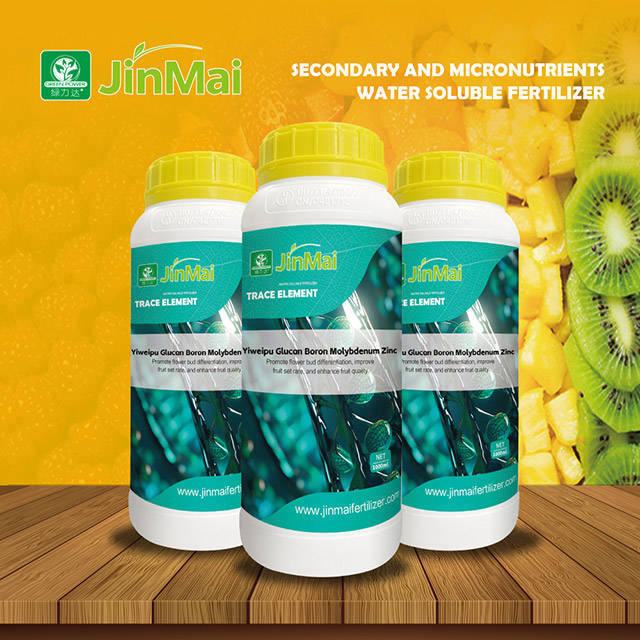
JINMAI-Yiweipu® High Boron Fertilizer with Zinc and Molybdenum is a premium liquid, water-soluble micronutrient complex designed to meet the key nutritional requirements of flowering and fruiting crops. It combines boron (B), zinc (Zn), molybdenum (Mo), and β-1,3-glucan in a synergistic formulation that not only improves nutrient uptake and utilization, but also stimulates plant immunity, enhances stress resilience, and supports reproductive development.
Unlike conventional single-nutrient solutions, this advanced formula delivers dual benefits:
1. Nutritional supplementation – rapid correction of boron, zinc, and molybdenum deficiencies that affect flower fertility and fruit set.
2. Biostimulant action – glucan polysaccharides trigger natural plant defense pathways, improving resistance to abiotic and biotic stress.
Its clear, fully soluble liquid form ensures seamless application in drip irrigation, fertigation, or foliar spraying without risk of clogging.
Function | Balanced Micronutrient Solution for Flowering, Fruit Setting, and Quality Enhancement |
Formula | B 100 g/L, Zn 10 g/L, Mo 5 g/L, β-1,3 Glucan |
| Density | 1.3 g/ml |
| pH (1:250) | 6.5±0.5 |
| Appearance | Transparent Yellow Liquid |
| Solubility | 100% Water Soluble |
| Release Type | Quick Release |
| Packaging | 1L Bottle (OEM/ODM Customization Available) |
| Origin | Shandong, China |
Increases pollen viability and fertilization efficiency, reducing issues such as flower drop and poor fruit set.
Promotes chlorophyll synthesis and sugar accumulation for stronger plant vitality and higher yields.
Corrects micronutrient deficiencies quickly, preventing physiological disorders like “empty flowering” and malformed fruits.
Glucan enrichment activates plant self-defense mechanisms, enabling crops to withstand environmental stress.
Improves fruit size, uniformity, color, and storage performance while increasing protein and auxin synthesis.
 | Fruit Trees⦁ Suitable Crops: Apple, pear, citrus, mango, grape ⦁ Function: Improves flowering intensity, fruit set, fruit weight, sweetness, and reduces premature fruit drop. |
 | Vegetables⦁ Suitable Crops: Tomato, cucumber, pepper, leafy greens ⦁ Function: Boosts pollination efficiency, yield stability, and disease resistance. |
 | Legumes⦁ Suitable Crops: Soybean, pea ⦁ Function: Enhances nitrogen fixation, pod filling, and seed protein content. |
 | Oil Crops⦁ Suitable Crops: Rapeseed, sunflower ⦁ Function: Supports better flowering, seed set, and oil accumulation. |
 | Field Crops⦁ Suitable Crops: Corn, wheat, cotton ⦁ Function: Improves grain filling, fiber quality, and final yield. |
Usage | Phenological Period | Dosage | Frequency |
| Foliar spray | Pre-flowering, bud differentiation | 0.3-0.6 L/ha (Dilute 1200-1500 times) | Every 10-14 days |
| Flowering, pollination, fruit set | 0.5-0.8 L/ha (Dilute 1200-1500 times) | Every 7-10 days | |
| Early pod / fruit development | 0.6-1 L/ha (Dilute 1200-1500 times) | Every 10-14 days |
Note: The specific usage and dosage can be adjusted according to the differences in regions, crop types, yields, etc, under the advice of technical personnel.
Pre-Flowering: Stimulates flower bud differentiation and pollen development.
Flowering: Improves pollen germination, enhances fertilization success, and reduces flower drop.
Early Fruit Development: Accelerates fruit enlargement, sugar synthesis, and stress resistance.
1. Mixing Order: When combining with other products, follow this sequence: water → this product → other products.
2. Compatibility: Compatible with most pesticides. Always conduct a compatibility test before first use.
3. Storage: Store in a cool, well-ventilated place, away from direct sunlight.
4. Safety: Keep out of reach of children; Not for human or animal consumption; In case of eye contact, rinse thoroughly with water and seek medical attention immediately.
High boron fertilizer with zinc and molybdenum is a liquid micronutrient fertilizer formulated with boron, zinc, molybdenum, and β-1,3 glucan. It is designed to support reproductive growth, flower development, fruit set, and overall crop quality.
Boron plays an important role in reproductive development, cell growth, pollen germination, and pollen tube development. Adequate boron nutrition can support flowering and improve fruit set when crops have sufficient boron availability.
Yes. Boron is closely associated with flowering and reproductive development. Providing adequate boron during the flowering period can help support pollen viability, pollen tube growth, fertilization, and fruit set.
Zinc is an essential micronutrient involved in enzyme activity, plant growth regulation, and normal crop development. Combining zinc with boron helps provide broader micronutrient support during important growth stages.
Molybdenum is required in small quantities for important plant metabolic processes, particularly nitrate utilization and nitrogen metabolism. Adding molybdenum can help maintain efficient nutrient utilization when crops require supplemental molybdenum.
High boron fertilizer can be used for fruit trees, vegetables, flowering crops, oilseed crops, and other crops with a boron requirement, provided the product is appropriate for the crop and application follows local recommendations.
Boron fertilizer is commonly applied during periods of active reproductive development, particularly before flowering, during flowering, and around fruit setting. The exact timing and application rate should be adjusted according to crop type, soil and tissue test results, and local agronomic recommendations.


