
T: +86-400-0987187
E: info@sdjinmai.com
E: info@sdjinmai.com
No. 6888 Jiankang East Street, High-tech Zone, Weifang, Shandong, China

Views: 0 Author: Site Editor Publish Time: 2026-04-16 Origin: Site
Modern agronomy is undergoing a significant transformation. Growers are moving beyond traditional NPK-only strategies and embracing more holistic, biostimulant-integrated programs. This shift directly addresses the core problems of high-intensity cultivation: "lazy roots" that fail to explore the soil, nutrient lockout that renders fertilizers useless, and long-term soil degradation. The solution isn't just another additive; it's about leveraging physiological regulators like humic acid. This powerful organic compound acts as both a soil conditioner and a plant growth stimulant. This technical guide provides growers and procurement managers with the essential knowledge to evaluate, select, and implement a High-Efficiency Rooting & Growth Solution, ensuring measurable root development and a strong return on investment.
Mechanism: Humic acid triggers ROS-dependent signaling and protects endogenous rooting hormones (IAA) from oxidation.
Soil Impact: Increases Cation Exchange Capacity (CEC) and acts as a "chelation bridge" for micronutrients.
Product Choice: Potassium Humate offers the highest solubility and concentration for commercial scaling.
Compatibility: Critical awareness of pH thresholds (avoiding <4.0) and calcium-based mixing risks.
ROI: Gains are realized through increased nutrient use efficiency (NUE) and reduced crop stress during drought or transplanting.
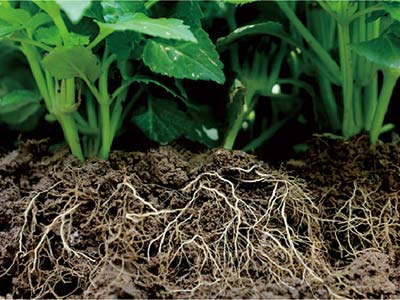
Understanding how a Humic Acid Fertilizer promotes root growth requires looking beyond simple nutrition. It functions as a biostimulant, directly influencing the plant's internal signaling and hormonal balance to build a more robust and efficient root system.
One of the most advanced findings in plant physiology is the role of Reactive Oxygen Species (ROS) as signaling molecules. While high concentrations of ROS cause cellular damage, low, controlled levels act as critical triggers for growth and development. Humic acid application initiates this process:
It triggers the production of controlled oxidative signals, such as superoxide (O₂⁻) and hydrogen peroxide (H₂O₂), primarily at the root tip.
This managed oxidative "stress" acts as a signal, prompting the root cells to elongate and divide more rapidly.
This process also leads to the upregulation of specific growth-regulating genes. For example, research in rice has shown increased expression of genes like OsTOR, a central growth regulator, and nutrient transporters like OsNRT2.1, which improves nitrate uptake.
Essentially, humic acid cues the plant to activate its own growth machinery at a genetic level, preparing it to absorb nutrients more effectively.
A common misconception is that humic acid contains rooting hormones. This is incorrect. Its power lies not in adding hormones but in protecting the plant's naturally produced ones. The primary rooting hormone in plants is Indole-3-Acetic Acid (IAA), a type of auxin.
Humic acid's role is to act as a stabilizer for IAA. It prevents the rapid enzymatic breakdown and oxidation of these crucial hormones in the rhizosphere. By protecting the plant's endogenous IAA, it maintains higher active concentrations for longer periods. This sustained hormonal signal results in more consistent and prolonged rhizogenesis, or new root formation.
The practical outcome of these biochemical interactions is a visible change in root architecture. A strong root system isn't just about a long taproot; it's about extensive lateral branching that maximizes the soil volume a plant can explore for water and nutrients. Data from controlled studies supports this effect. Scientific research has demonstrated that applying humic substances can lead to significant physical changes:
Increased Root Dry Weight: Studies have reported increases of up to 27% in root biomass.
Enhanced Lateral Branching: The same research noted a corresponding increase in lateral root length and density of up to 20%.
This development is crucial for crop resilience. A larger, more branched root system provides better anchorage, superior water uptake during dry spells, and more efficient access to immobile nutrients like phosphorus.
To fully appreciate the value of humic acid, you must evaluate it through three distinct but interconnected lenses: its physical impact on soil structure, its chemical effect on nutrient availability, and its biological role in the soil food web.
Healthy soil is not just a collection of mineral particles; it's a structured medium. Humic acid is a master architect of this structure. Its large, complex molecules act as a natural glue, binding small soil particles (sand, silt, and clay) into larger, more stable units called aggregates. This has several direct benefits:
Improved Aeration and Drainage: Better aggregation creates macropores, allowing oxygen to reach roots and preventing waterlogging.
Increased Water-Holding Capacity (WHC): The porous nature of these aggregates acts like a sponge, holding onto plant-available water for longer. This directly reduces drought-induced root senescence (aging and die-back).
Reduced Erosion: Stable aggregates are less likely to be washed or blown away, preserving valuable topsoil.
Perhaps the most powerful function of humic acid is its ability to chelate nutrients. Chelation is a process where a large organic molecule, the humic acid, wraps around a positively charged mineral ion. This mechanism prevents nutrients from becoming unavailable to plants.
Think of a humic molecule as a "claw" (from the Greek word chele). This claw grabs onto essential micronutrients like iron (Fe), zinc (Zn), manganese (Mn), and copper (Cu). In high-pH or alkaline soils, these micronutrients would normally react with other elements and form insoluble compounds, a phenomenon known as "lockout." By chelating them, humic acid keeps them in a soluble, plant-available form. It acts as a bridge, holding the nutrient and transferring it to the plant root upon demand.
This process also unlocks major nutrients. It is particularly effective at enhancing phosphorus solubility. In many soils, phosphorus binds with calcium to form insoluble calcium phosphate. Humic acid can intervene, breaking these bonds and making the phosphorus accessible to the crop.
The soil is a living ecosystem teeming with billions of microorganisms. These microbes are essential for nutrient cycling, disease suppression, and overall soil health. Humic acid provides a direct benefit to this vital community.
Carbon Source: Humic substances are a rich source of stable carbon, which is the primary food for beneficial soil microbes. A well-fed microbial population is more active and efficient at breaking down organic matter and releasing nutrients.
Synergy with Beneficials: Humic acid creates an ideal environment for symbiotic organisms to thrive. It enhances the effectiveness of mycorrhizal fungi, which extend the plant's root system, and Plant Growth-Promoting Rhizobacteria (PGPR), which can fix nitrogen and solubilize minerals.
Not all humic products are created equal. The source material, processing method, and final format all determine the efficacy and suitability for your specific agricultural operation. Making an informed choice is key to achieving the desired results.
The quality of a Humic Acid Fertilizer begins with its source. The industry standard for high-quality, highly active humic substances is Leonardite. Leonardite is a specific type of soft, earthy lignite coal that has not completed the full coalification process. It is exceptionally rich in humified organic matter, making it superior to other sources like peat or compost.
Leonardite-Derived Humates: Offer the highest concentration of humic and fulvic acids, ensuring maximum biological activity per unit.
Peat or Compost Sources: While beneficial, these typically have lower concentrations of active humic substances and may contain more inert material.
Humic products are available in several formats, each with distinct advantages for different application systems and operational scales. The choice depends on your goals, equipment, and budget.
| Format | Primary Use Case | Release Speed | Pros | Cons |
|---|---|---|---|---|
| Granular Humic Acid | Pre-planting soil conditioning, broadcast spreading | Slow-release | Long-term soil building, easy to handle and blend with dry fertilizers. | Lower immediate plant uptake, less precise for corrective action. |
| Liquid Humic Concentrates | Fertigation, drip irrigation, foliar sprays | Fast-acting | High precision, rapid root zone correction, easily integrated into liquid feeding programs. | Higher transport and storage costs due to water content, can be less concentrated. |
| Soluble Potassium Humate | All liquid applications (fertigation, hydroponics, foliar) | Instantaneous | Maximum concentration, fully soluble, highly versatile, cost-effective for large-scale liquid mixing. | Requires careful handling as a fine powder, must be mixed on-site. |
For most commercial operations seeking a High-Efficiency Rooting & Growth Solution, soluble Potassium Humate is the industry standard due to its unmatched concentration, versatility, and cost-effectiveness at scale.
When reviewing a product's technical data sheet, focus on these key metrics:
Solubility Percentage: For liquid applications, this should be as close to 100% as possible to prevent clogging of irrigation emitters and filters.
pH Stability Range: A quality product will remain stable and effective across a broad pH range typical of agricultural soils and nutrient solutions.
Active Humic vs. Fulvic Acid Ratios: Understand the composition. Humic acid is best for soil structure and long-term nutrient holding, while fulvic acid is smaller and excels at nutrient transport into the plant. A balanced product is often ideal.
Choosing the right product is only half the battle. Proper implementation—timing, dosage, and compatibility—is what unlocks the full potential of humic acid and prevents costly operational mistakes.
Applying humic acid during critical growth stages provides the greatest benefit to the plant. Targeting these windows ensures the root system is prepared for future demands.
The "Transplant Window": Applying humic acid during or immediately after transplanting is one of the most effective strategies. It dramatically reduces transplant shock by stimulating rapid new root hair growth, allowing the plant to establish itself quickly and access water and nutrients in its new environment.
Early Vegetative Stage: Applications during the initial weeks of growth help build the plant's "root engine." A robust and expansive root system developed early on will support vigorous top growth and is essential for maximizing yield potential during the later reproductive phase.
Dosage varies by crop, soil type, and application method. Always start with the manufacturer's recommendations and adjust based on observation. However, some general commercial benchmarks exist:
Soil Drenching / Fertigation: This is the primary and most effective method. Typical rates for soluble potassium humate range from 2 to 5 kg per hectare, applied through the irrigation system.
Foliar Application: While less common for root development, foliar sprays can act as a secondary booster, especially when combined with nutrient sprays. Humic acid on leaves can increase stomatal opening and nutrient absorption. Concentrations are much lower, typically around 0.5 to 1 gram per liter of water.
This is where practical experience is crucial. Humic acid is a powerful tool, but it can cause significant problems if mixed improperly. Understanding its chemical behavior is non-negotiable for large-scale operations.
Humic acid molecules are large and soluble in alkaline or neutral conditions. However, they will precipitate (fall out of solution) in highly acidic environments.
Common Mistake: Mixing concentrated humic acid solutions with highly acidic fertilizers (e.g., some phosphorus fertilizers) that drop the tank mix pH below 4.0. This causes the humic acid to turn into a sludge, which can clog filters, drip emitters, and nozzles, leading to costly downtime and cleanup.
Humic acid can react with high concentrations of free calcium ions.
What to Watch For: When mixing humic acid with high-calcium fertilizers like calcium nitrate in a concentrated stock tank, a reaction can occur that causes "salting out" or precipitation of calcium humate. Best practice is to use separate stock tanks for humic acids and calcium-based products or to ensure significant dilution before they are combined.
An often-overlooked benefit is humic acid's ability to act as an adjuvant for certain soil-applied pesticides. Through complexation, it can bind to pesticide molecules, protecting them from microbial degradation in the soil. This can extend their efficacy and residual activity, potentially allowing for reduced application rates of fungicides or insecticides.
Investing in a high-quality humic acid program delivers returns that go far beyond just yield increases. The economic value is driven by improved efficiency, risk mitigation, and the enhancement of your most valuable asset: the soil.
This is the most direct and measurable ROI driver. By preventing nutrient lockout and improving root absorption, humic acid increases the "recovery rate" of the fertilizers you apply. For example, if your crop only utilizes 50% of the applied phosphorus, a humic acid program might increase that to 65%. This means you achieve the same or better results with less NPK input, directly reducing annual fertilizer costs. It makes every dollar spent on fertilizer work harder.
What is the value of a crop that survives a heatwave when a neighbor's doesn't? Humic acid provides tangible "crop insurance" against abiotic stresses like drought, heat, and salinity.
Drought Tolerance: Improved soil structure and water-holding capacity mean plants can withstand dry periods longer.
Salinity Buffering: Humic substances can buffer against high salt concentrations in the root zone, reducing the osmotic stress that inhibits water uptake.
Quantifying this value involves assessing the potential crop loss you avoid during a stressful season. In many climates, this benefit alone can justify the investment.
Conventional agriculture can sometimes treat soil like a disposable medium—a practice of "mining" nutrients. Incorporating humic acid shifts this paradigm to one of "building" soil. The long-term value is immense. By increasing soil organic matter, improving structure, and fostering microbial life, you enhance the land's intrinsic value and productivity for seasons to come. This regenerative approach reduces reliance on synthetic inputs over time and creates a more resilient and sustainable farming operation.
To confirm the ROI of your humic acid program, it's important to track key performance indicators (KPIs) beyond final yield:
Root-to-Shoot Ratios: Periodically sample plants to compare the biomass of the roots versus the above-ground foliage. A higher ratio indicates a stronger foundation.
Sap Analysis: Plant sap analysis can provide real-time data on the nutrient levels within the plant, offering direct evidence of improved uptake efficiency.
Water Usage: Monitor irrigation records. Improved soil WHC may lead to measurable reductions in water consumption.
Humic acid is far more than a simple fertilizer additive; it is a foundational tool for building resilient, high-performance cropping systems. Its ability to restructure soil, unlock nutrients, and stimulate the plant's own growth mechanisms makes it an essential component of modern agronomy. For growers seeking a high-efficiency rooting solution, the evidence is clear: success hinges on choosing a high-quality product and implementing it strategically. The key is to ensure that your choice of source material and application method aligns with your specific soil chemistry and operational goals.
For a final recommendation, begin with a pilot block. Use a section of your operation to calibrate dosage and application timing against your specific soil's Cation Exchange Capacity and crop needs. This allows you to witness the results firsthand and scale the program with confidence. The next logical step is to review the technical data sheets (TDS) for a high-solubility, Leonardite-sourced Potassium Humate to ensure it meets your operational standards for purity and performance.
A1: No, it is not a replacement. A Humic Acid Fertilizer acts as a conditioner and an enhancer. It contains minimal NPK values. Its primary role is to make your traditional fertilizers work more efficiently by improving soil structure and increasing nutrient availability and uptake, allowing you to potentially reduce your overall NPK usage over time.
A2: The physiological signaling within the plant begins almost immediately. Visible results, such as the development of new, fine root hairs and increased lateral branching, can typically be observed within 7 to 14 days after a soil drench application, depending on the crop, growth stage, and environmental conditions.
A3: Yes, but product selection is critical. You must use a highly filtered, 100% water-soluble potassium humate product. Using a lower-quality or less soluble form can lead to the formation of biofilm in tanks and reservoirs or cause clogging in small drippers and emitters, which can be detrimental to a hydroponic system.
A4: They work synergistically but have different primary functions. Humic acid, with its larger molecules, is the workhorse for improving soil structure, increasing water retention, and boosting long-term Cation Exchange Capacity (CEC). Fulvic acid has much smaller molecules, allowing it to easily enter plant roots and leaves, making it excellent for rapid nutrient transport and foliar uptake.
A5: It has a minimal direct effect on changing the soil's actual pH value. However, its major benefit is improving the soil's buffering capacity. This means it helps the soil resist drastic pH swings when acidic or alkaline fertilizers are applied, creating a more stable and favorable environment for root growth and nutrient availability.


