T: +86-400-0987187
E: info@sdjinmai.com
E: info@sdjinmai.com
No. 6888 Jiankang East Street, High-tech Zone, Weifang, Shandong, China
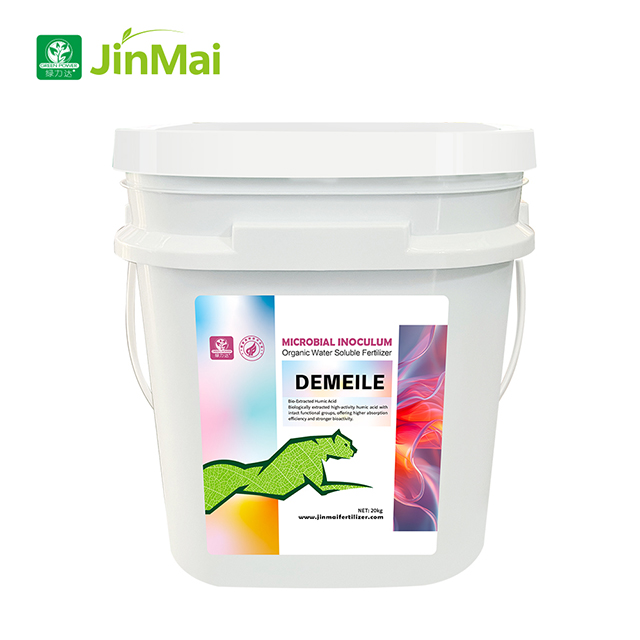


| Quantity: | |
|---|---|

JINMAI DEMEILE® Bio-Extracted Humic Acid is a premium liquid humic formulation produced through advanced microbial fermentation and enzymatic biotransformation of natural Russian woody peat. Unlike conventional alkali-extracted humic acids, this product preserves the natural macromolecular structure and functional groups of humic substances, resulting in higher biological activity, improved nutrient chelation, and superior soil conditioning performance.
By integrating biologically active humic and fulvic fractions with readily available nitrogen and potassium, DEMEILE® serves as both a soil amendment and a nutrient efficiency enhancer, suitable for modern sustainable agriculture and intensive cropping systems.
Formula | N 60g/L, K2O 20g/L, Organic Matter 290g/L, Humic Acid 200g/L, Fulvic Acid 30 g/L |
Appearance | Dark Brown Liquid |
| Release Type | Quick |
| Model Number | 20kg |
| Density | 1.15 g/ml |
| pH (1:250) | 6.0-8.0 |
| Characteristic | 100% Water Soluble |
| Function | Root Growth, Nutrient Uptake, Soil Improvement |
| Application | Field Crops, Vegetables, Fruit Trees, Cash Crops, Horticulture |
| Origin | Shandong, China |
| OEM&ODM | Logo, Label, Formula, Package Customized |
Enhances soil aggregation and porosity, improving aeration and root penetration
Increases soil organic matter content and activates beneficial soil microorganisms
Improves water-holding capacity and reduces nutrient leaching
Stimulates primary and lateral root growth, increasing effective root surface area
Enhances chelation and transport of nitrogen, potassium, and micronutrients
Improves overall fertilizer use efficiency and nutrient uptake consistency
Strengthens crop tolerance to salinity, drought, temperature stress, and transplant shock
Promotes stable vegetative growth under adverse environmental conditions
Contributes to higher yield potential and improved crop uniformity
Supports better flowering, fruit set, and fruit expansion
Improves crop quality parameters such as size, color, sugar accumulation, and marketability
 | Field Crops⦁ Suitable Crops: Corn, wheat, rice, soybean ⦁ Function: Stronger root systems, improved nutrient efficiency, stable yield increase |
 | Vegetables⦁ Suitable Crops: Tomato, pepper, cucumber, leafy greens ⦁ Function: Faster establishment, improved fruit setting, enhanced quality |
 | Fruit Trees⦁ Suitable Crops: Citrus, apple, grape, banana ⦁ Function: Improved root zone activity, better fruit size and coloration |
 | Cash Crops⦁ Suitable Crops: Cotton, sugarcane, tobacco ⦁ Function: Enhanced stress resistance and nutrient absorption |
 | Horticulture⦁ Suitable Crops: Flowers, turf, nursery plants ⦁ Function: Improved root development and transplant survival |
Application Method | Dosage | Dilution Ratio | Frequency |
| Soil Application / Drip Irrigation | 5–10 kg/ha | 1:300–500 | Apply evenly to the root zone; repeat 2–3 times during the growing season |
| Fertilizer Blending | 3–8% of total solution volume | As required | Compatible with most liquid fertilizers and water-soluble nutrients; jar test recommended |
| Base Soil Conditioning (Pre-plant) | 8–15 kg/ha | 1:300–400 | Apply during soil preparation to improve soil structure and activate organic matter |
Note: The specific usage and dosage can be adjusted according to the differences in regions, crop types, yields, etc, under the advice of technical personnel.
Soil Preparation / Pre-planting: To improve soil structure and activate organic matter
Early Vegetative Stage: To stimulate root development and nutrient uptake
Flowering and Fruit Expansion: To enhance nutrient transport and improve yield and quality
Stress Periods: Before or after drought, salinity stress, or temperature fluctuations
1. Mixing Order: When combining with other products, follow this sequence: water → this product → other products.
2. Compatibility: Compatible with most pesticides. Always conduct a compatibility test before first use.
3. Storage: Store in a cool, well-ventilated place, away from direct sunlight.
4. Safety: Keep out of reach of children; Not for human or animal consumption; In case of eye contact, rinse thoroughly with water and seek medical attention immediately.
Bio-Extracted Humic Acid Liquid Fertilizer is a biologically extracted liquid formulation containing 290 g/L organic matter, 200 g/L humic acid, 30 g/L fulvic acid, 60 g/L nitrogen, and 20 g/L K₂O. Its high-activity humic substances are designed to support soil health, root development, and crop nutrient utilization.
Liquid humic acid helps improve the root-zone environment and supports root growth, nutrient availability, and nutrient uptake. When incorporated into a balanced fertilization program, it can also help improve fertilizer efficiency and promote healthy crop growth.
The main difference is the formulation. This product is supplied as a ready-to-use liquid, making it convenient for fertigation and liquid fertilizer programs. It also contains nitrogen and potassium, providing additional crop nutrition alongside humic acid, fulvic acid, and organic matter.
Yes. Liquid humic acid fertilizer can be incorporated into drip irrigation and fertigation programs, subject to proper dilution and system compatibility. Its liquid formulation allows convenient application to the crop root zone.
It is suitable for a wide range of crops, including fruit trees, vegetables, field crops, cash crops, greenhouse crops, and melons. It can be integrated into soil and crop nutrition programs throughout different growth stages.
Liquid humic acid can be applied during key stages such as transplant establishment, root development, vegetative growth, flowering, fruit development, and crop recovery periods. Regular root-zone application through fertigation can help maintain soil biological activity and support efficient nutrient uptake.